

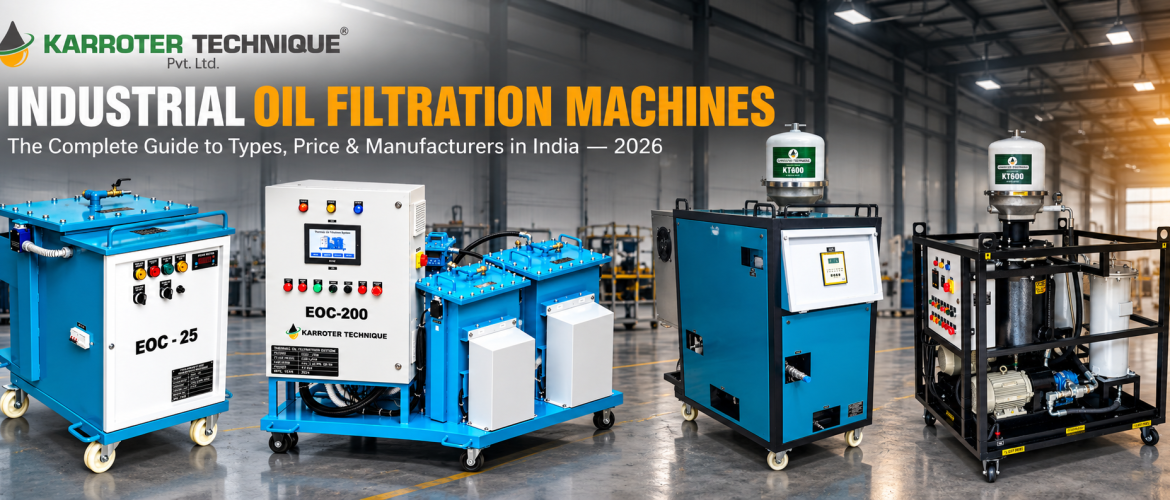
Industrial oil filtration machines are the single most cost-effective piece of equipment most Indian plants haven’t budgeted for yet. If you’re researching this category, you’re likely dealing with one of two situations: unplanned downtime traced back to dirty oil, or a genuine effort to get ahead of maintenance costs before they become breakdown costs. Either way, this guide covers everything you need what industrial oil filtration machines actually are, the different types available and how to tell them apart, how much they cost in India in 2026, which manufacturers to evaluate in Pune and nationally, and how to pick the right one for your specific oil type and plant. By the end, you’ll be able to walk into a supplier conversation knowing exactly what to ask for, rather than relying on whatever a single salesperson happens to recommend.
What Is an Industrial Oil Filtration Machine?
An industrial oil filtration machine is equipment designed to continuously remove contamination solid particles, water, sludge and carbon from industrial oils, restoring the oil’s original performance without requiring a full oil change. Every type of industrial oil, whether hydraulic, lube, gear, transformer, quenching or thermic, degrades over time as contamination builds up from normal operation. An industrial oil filtration machine intervenes in that process, running alongside your equipment to keep oil condition close to new rather than letting it decline until the next scheduled change.
Why Industrial Oil Filtration Machines Matter for Equipment Reliability
Contaminated oil is one of the leading, and most preventable, causes of industrial equipment failure. Fine particles accelerate wear on pumps, bearings and valves; water ingress causes corrosion and reduces lubricating film strength; and carbon or sludge buildup insulates heat-transfer surfaces and clogs fine passages. An industrial oil filtration machine addresses all of this at the source, which is why plants that adopt continuous filtration typically see fewer unplanned breakdowns and longer intervals between full oil changes. The cost math tends to favour filtration once you account for the full picture: lost production during an unplanned stoppage, emergency repair costs, and expedited spare-parts shipping almost always outweigh the price of the filtration equipment that would have prevented the failure in the first place.
Types of Industrial Oil Filtration Machines
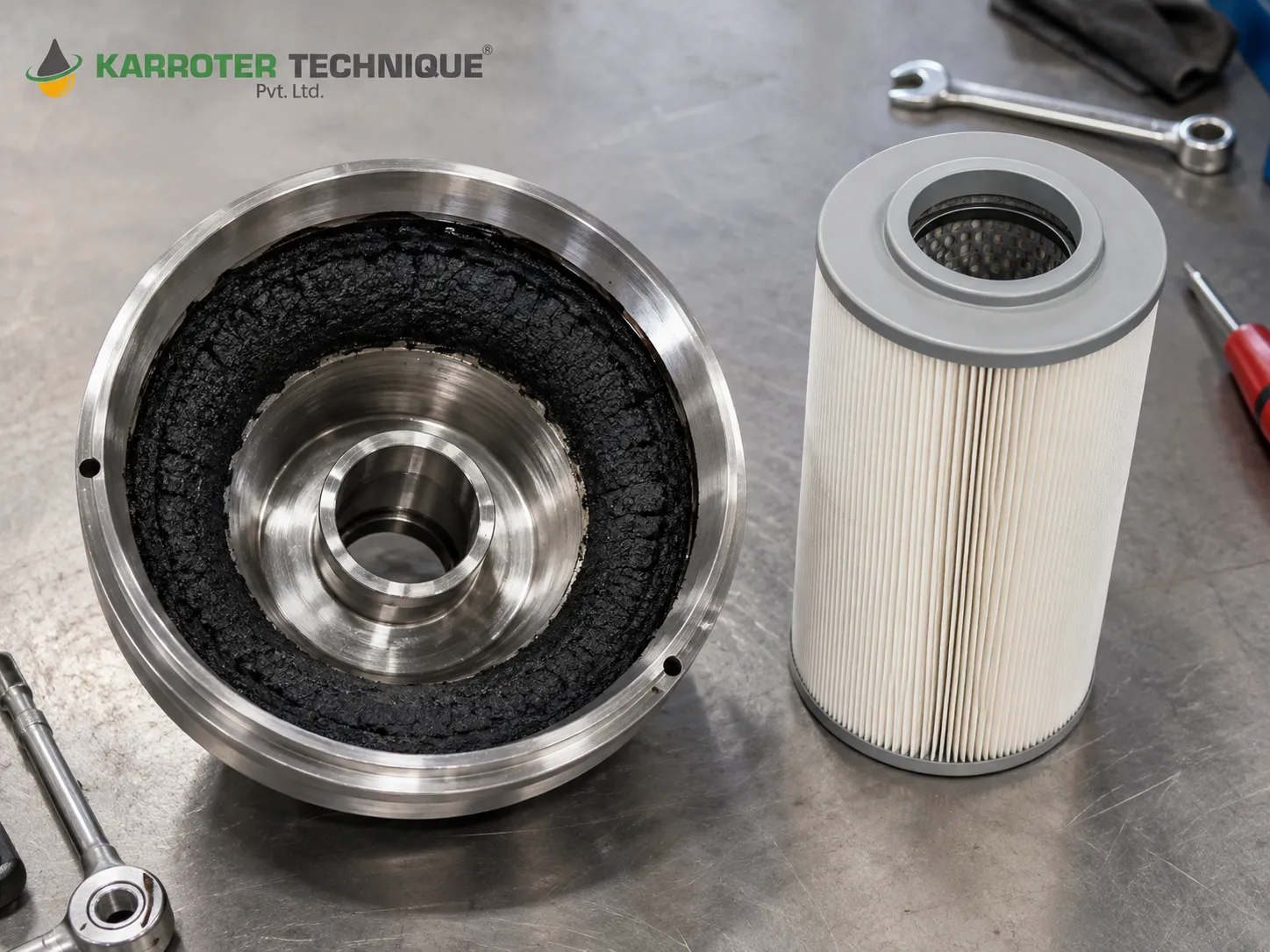 Not all industrial oil filtration machines work the same way, and picking the wrong type for your application is the single most common buying mistake. Here’s how the main categories differ.
Centrifugal Oil Filtration Machines
Centrifugal industrial oil filtration machines spin oil at high speed inside a cleanable rotor, using centrifugal force to separate soot, carbon and fine solids by density. There’s no disposable filter element the rotor is cleaned and reused indefinitely which makes centrifugal machines the standard choice wherever continuous, consumable-free filtration matters most, including quenching oil, thermic fluid, and general lube oil applications.
Hydraulic Oil Filtration Machines
Hydraulic oil filtration machines are built specifically for the high-pressure, fine-tolerance world of hydraulic systems, where even sub-micron contamination can damage precision valves and pumps. These systems typically combine multiple filtration stages to hit tight cleanliness targets (often measured against ISO 4406 codes) that hydraulic equipment manufacturers specify.
Electrostatic Oil Filtration Machines
Electrostatic oil filtration machines use an electrical charge to attract and remove varnish precursors and extremely fine sub-micron particles that mechanical filtration can’t catch. They’re particularly effective on turbine and hydraulic oils prone to varnish formation, and are often run alongside a mechanical filtration system rather than as a standalone solution.
Vacuum Dehydration Oil Filtration Machines
Vacuum-based industrial oil filtration machines use reduced pressure (and sometimes heat) to pull dissolved and free water and gases out of oil a job mechanical and centrifugal filtration can’t do on their own. These are common on transformer, turbine and gearbox oils where moisture content is a critical failure driver.
Transformer Oil Filtration Machines
A specialised category of vacuum-based industrial oil filtration machine designed to restore Breakdown Voltage (BDV) and remove moisture and gases from transformer insulating oil, often built with heated evacuation chambers for faster processing.
Cartridge / Mesh Oil Filtration Machines
The simplest and least expensive category oil passes through a disposable filter element that physically traps particles. Effective for light-duty or intermittent use, but the ongoing cost of replacement cartridges makes this the most expensive option over a machine’s working life for continuous, heavy-duty applications.
| Type | Best For | Removes | Consumables |
| Centrifugal | Quenching, thermic, lube, gear oils | Soot, carbon, fine solids | None cleanable rotor |
| Hydraulic-specific | High-pressure hydraulic circuits | Fine particulate to sub-micron levels | Depends on design |
| Electrostatic | Turbine & hydraulic oil, varnish control | Sub-micron particles, varnish precursors | Collector plates (periodic cleaning) |
| Vacuum dehydration | Transformer, turbine, gearbox oils | Dissolved water, gases | None mechanical process |
| Transformer-specific | Transformer insulating oil | Moisture, gases, low BDV | None |
| Cartridge / mesh | Light-duty, intermittent use | Larger particles | Disposable elements recurring cost |
How Does an Industrial Oil Filtration Machine Work?
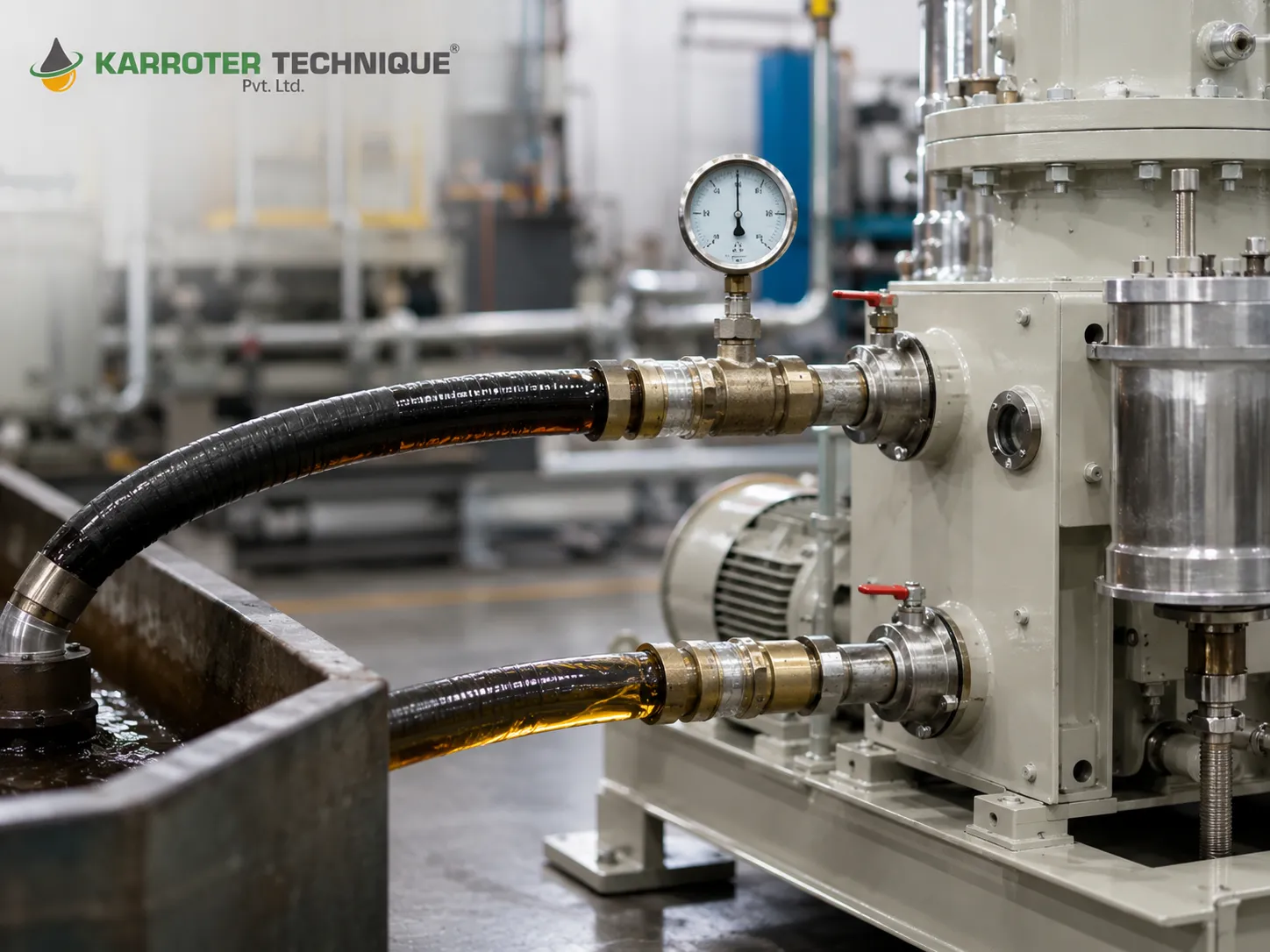 Most industrial oil filtration machines work by drawing oil out of a tank or system, passing it through a separation stage centrifugal, electrostatic, vacuum or mechanical and returning cleaner oil continuously while equipment keeps running. The specific mechanism depends on the type: centrifugal units spin oil to separate solids by density, vacuum units use pressure differential and often heat to pull out moisture, and electrostatic units use charged plates to attract fine particles. What almost all well-designed industrial oil filtration machines share is offline, continuous operation filtering in parallel with production rather than requiring a shutdown.
Signs Your Plant Needs an Industrial Oil Filtration Machine
If any of the following are showing up on your floor, it’s worth evaluating a dedicated industrial oil filtration machine rather than continuing with reactive oil changes:
- Oil that looks dark, cloudy or hazy well before its scheduled change interval
- Rising particle counts or failed cleanliness tests on lab oil analysis
- Increased pump, valve or bearing wear traced back to oil condition
- Water contamination visible as a milky appearance or detected through testing
- Frequent clogging of existing strainers, cartridges or mesh filters
- Equipment downtime that keeps tracing back to oil-related failures
Benefits of Installing an Industrial Oil Filtration Machine
- Extended oil life, reducing purchase and disposal frequency
- Fewer unplanned breakdowns caused by contamination-related wear
- Lower total cost of ownership compared to reactive full oil changes, especially with consumable-free centrifugal designs
- Consistent equipment performance, since oil condition stays close to new rather than declining between changes
- Reduced environmental and compliance burden from smaller disposal volumes
- No production downtime with offline, continuous-filtration designs
Applications & Industries That Use Industrial Oil Filtration Machines
Industrial oil filtration machines are used across nearly every sector that runs oil-lubricated or oil-cooled equipment:
- Power generation and turbine operations
- Cement, steel and heavy manufacturing plants
- Automotive and component manufacturing
- Marine and shipping
- Forging, fastener and bearing manufacturing (quenching oil)
- Textile, chemical and process plants (thermic fluid systems)
- Injection molding and plastics processing
- Stone crushing and construction equipment fleets
Industrial Oil Filtration Machine Price in India – What Affects the Cost?
This is one of the first questions plant engineers search, and the honest answer is that price varies enormously by type and capacity. Based on current Indian market listings, basic entry-level cartridge units start as low as ₹12,000–₹50,000, mid-capacity centrifugal and hydraulic filtration systems typically range ₹1.5–5 lakh, and larger automated systems particularly PLC-controlled transformer or vacuum dehydration units can run from ₹4.5 lakh up to several lakh more depending on flow rate and automation.
| Factor | Impact on Price |
| Filtration technology | Centrifugal and vacuum systems cost more upfront than basic cartridge units but reduce recurring costs |
| Flow rate / capacity | Higher throughput requires larger motors, rotors or vacuum chambers |
| Automation level | PLC controls, sensors and auto-testing (as seen on transformer BDV units) raise price |
| Oil type specialisation | Transformer and precision hydraulic applications often cost more than general-purpose units |
| After-sales support | Installation, commissioning and local service coverage affect total cost of ownership |
Industrial Oil Filtration Machine Manufacturers in India
India has a large and varied base of industrial oil filtration machine manufacturers, ranging from broad catalog suppliers covering every oil type to specialists focused on one filtration method. Evaluate manufacturers against a short, practical checklist rather than price alone:
- Technology fit for your oil type a manufacturer strong in transformer oil filtration isn’t automatically the right choice for quenching or thermic applications
- Consumable-free design where possible centrifugal technology avoids locking you into recurring cartridge costs
- Correct capacity sizing based on your actual tank volume and duty cycle, not a generic standard model
- Local installation and commissioning support, especially valuable outside major industrial hubs
- After-sales service response time ask directly how quickly a technician can reach your plant
Industrial Oil Filtration Machines in Pune
Pune is one of India’s strongest industrial hubs for oil filtration equipment, with a dense cluster of automotive, forging, and manufacturing plants driving steady demand for industrial oil filtration machines. If your plant is based in or near Pune, a locally based manufacturer offers real practical advantages faster installation, easier access to spares, and quicker service response. Karroter Technique is based in Narhe, Pune, and designs, manufactures and commissions industrial oil filtration machines for plants across India.
Karroter’s Range of Industrial Oil Filtration Machines
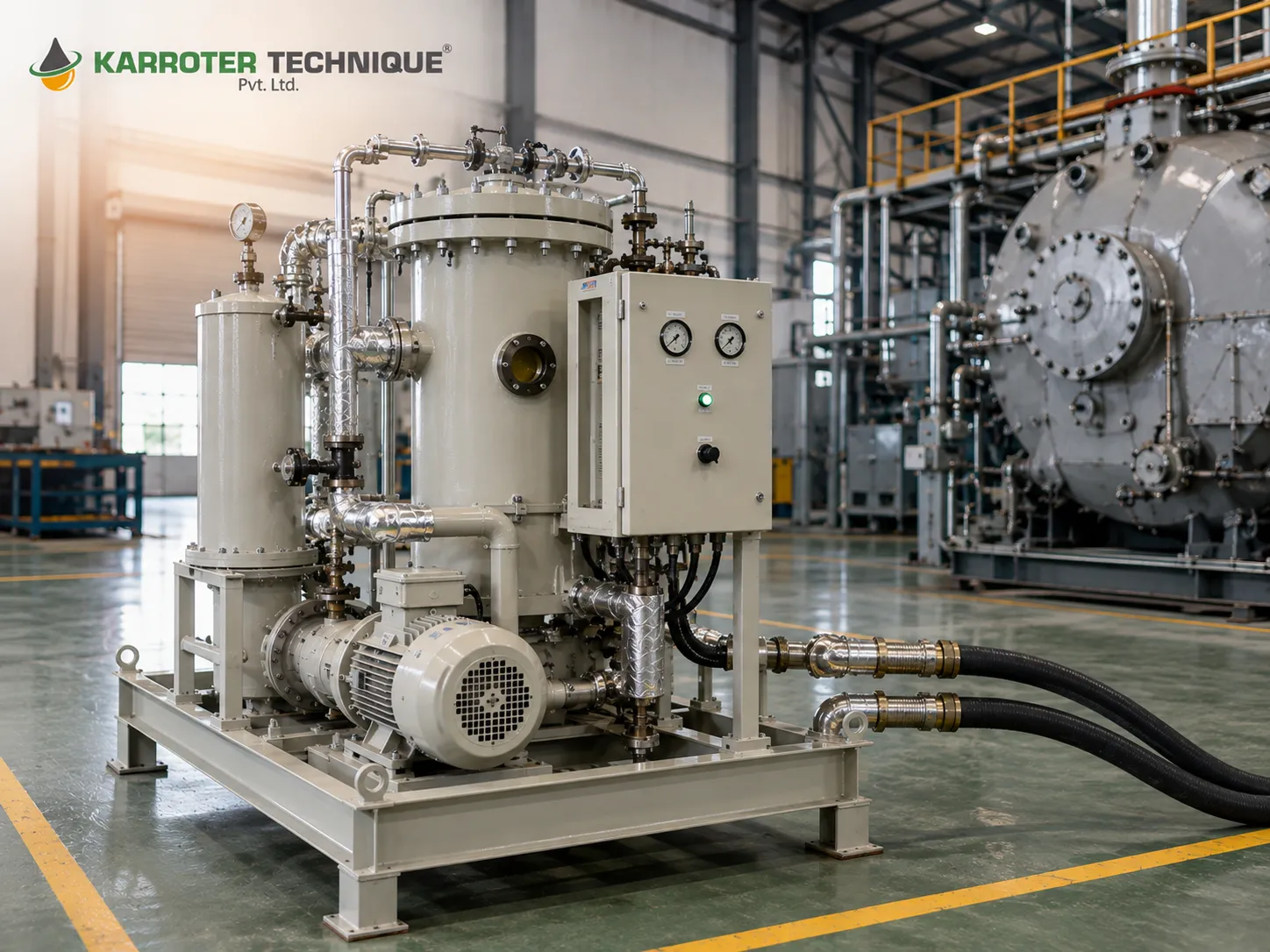 Karroter builds centrifugal industrial oil filtration machines across several product lines, all sharing the same consumable-free separation technology:
| Product | Best For |
| Centrifugal Oil Cleaner | General lube, gear and hydraulic oil cleaning |
| Centrifugal Oil Filtration Skids | Skid-mounted systems for heat treatment (quenching) and thermic fluid applications |
| Mechanical / Hydraulic Filtration System | High-pressure hydraulic circuits requiring fine particulate control |
| Electrostatic Oil Cleaning Machines | Sub-micron and varnish-prone turbine and hydraulic oils |
If your plant runs quenching or thermic fluid systems specifically, our dedicated guides go deeper into those applications seee our quenching oil filtration guide and thermic oil filtration guide for capacity tables and pricing specific to each use case. (Links resolve once both guides are published.)
How to Choose the Right Industrial Oil Filtration Machine
- Identify your oil type first. Hydraulic, lube, transformer, quenching and thermic applications each favour a different filtration method don’t buy a generic unit before confirming the technology fits.
- Know your actual tank volume and flow rate. Undersizing limits throughput; oversizing wastes capital.
- Decide between consumable and consumable-free technology. Centrifugal and vacuum systems cost more upfront but eliminate ongoing cartridge purchases.
- Check contamination targets. If you need a specific ISO 4406 cleanliness code, confirm the machine is rated to hit it.
- Consider automation needs. Sensors, HMI controls and auto-testing add cost but reduce manual monitoring.
- Evaluate after-sales support, not just the purchase price an industrial oil filtration machine is a long-term asset.
Maintenance Best Practices for Industrial Oil Filtration Machines
- Follow the manufacturer’s clean-out or element-replacement schedule rather than waiting for visible performance drops reactive maintenance on an industrial oil filtration machine usually costs more in the long run than a fixed schedule.
- Test oil condition periodically (particle count, moisture, viscosity) to catch trends before they cause damage.
- Inspect suction and return lines during routine maintenance to avoid unnoticed leaks or restrictions.
- Keep records by equipment and oil type, so any drift in contamination levels is caught quickly.
- Match filtration run time to duty cycle heavier contamination loads need more frequent or longer filtration cycles.
- Train at least one on-site technician on the specific industrial oil filtration machine your plant runs, rather than depending entirely on the manufacturer for routine checks.
Industrial Oil Filtration Machine vs Full Oil Change – Which Costs Less?
| Factor | Full Oil Change | Industrial Oil Filtration Machine |
| Recurring cost | New oil purchase every cycle | One-time investment, minimal running cost (centrifugal) |
| Downtime | Equipment stopped during drain and refill | None with offline, continuous designs |
| Consistency | Oil quality declines steadily until next change | Stays close to original condition continuously |
| Disposal | Regular hazardous-waste disposal volume | Smaller disposal footprint (sludge/water only) |
| Long-term cost | Higher over 2–3 years for continuously used equipment | Lower after the initial payback period |
For low-usage or standby equipment, periodic oil changes may still make sense. But for any plant running equipment continuously or near-continuously, relying on full oil changes alone is an expensive, avoidable pattern that a properly chosen industrial oil filtration machine removes.
Frequently Asked Questions
What is an industrial oil filtration machine used for?
An industrial oil filtration machine is used to continuously remove contamination solid particles, water, sludge or carbon from industrial oils like hydraulic, lube, transformer, quenching and thermic fluids, extending oil life and protecting equipment from contamination-related wear.
How does an industrial oil filtration machine work?
Most industrial oil filtration machines draw oil from a tank or system, pass it through a separation stage (centrifugal, vacuum, electrostatic or mechanical), and return cleaner oil continuously typically running offline and in parallel with production so there’s no need to shut equipment down.
What is the price of an industrial oil filtration machine in India?
Prices range widely by type and capacity basic cartridge units start around ₹12,000–₹50,000, mid-capacity centrifugal and hydraulic systems typically run ₹1.5–5 lakh, and larger automated or vacuum dehydration systems can cost significantly more depending on flow rate and features.
Which type of industrial oil filtration machine is best?
There’s no single best type the right choice depends on your oil type and contamination profile. Centrifugal machines suit quenching, thermic and general lube oils; vacuum dehydration suits transformer and turbine oils with moisture issues; electrostatic units target sub-micron and varnish contamination.
Do industrial oil filtration machines need consumables?
It depends on the technology. Centrifugal and vacuum dehydration machines are largely consumable-free, using cleanable rotors or mechanical separation, while cartridge-based machines require periodic filter element replacement, which adds up as a recurring cost.
Can an industrial oil filtration machine run while equipment is operating?
Yes, in most modern designs. Offline units draw from and return to the oil system continuously, filtering in parallel with production rather than requiring a shutdown.
How do I choose an industrial oil filtration machine manufacturer in India?
Look for proven experience with your specific oil type, consumable-free technology where possible, correct capacity sizing for your tank and duty cycle, local installation support, and a clear after-sales service response time.
The Bottom Line
An industrial oil filtration machine turns oil-related downtime from an ongoing cost of doing business into a solved problem. Whether your plant is dealing with contaminated hydraulic fluid, moisture in transformer oil, or carbon buildup in quenching or thermic systems, the right industrial oil filtration machine matched correctly to your oil type and duty cycle pays for itself through fewer breakdowns, longer oil life, and lower long-term cost compared to relying on full oil changes alone.
Not Sure Which Industrial Oil Filtration Machine Fits Your Plant?
Tell us your oil type, tank capacity and contamination challenge, and get in touch with Karroter we’ll recommend the right system for you.
For further technical background on how oil cleanliness is measured across industrial applications, see this independent explainer on ISO 4406 vs NAS 1638 cleanliness standards.
Related reading from Karroter: