

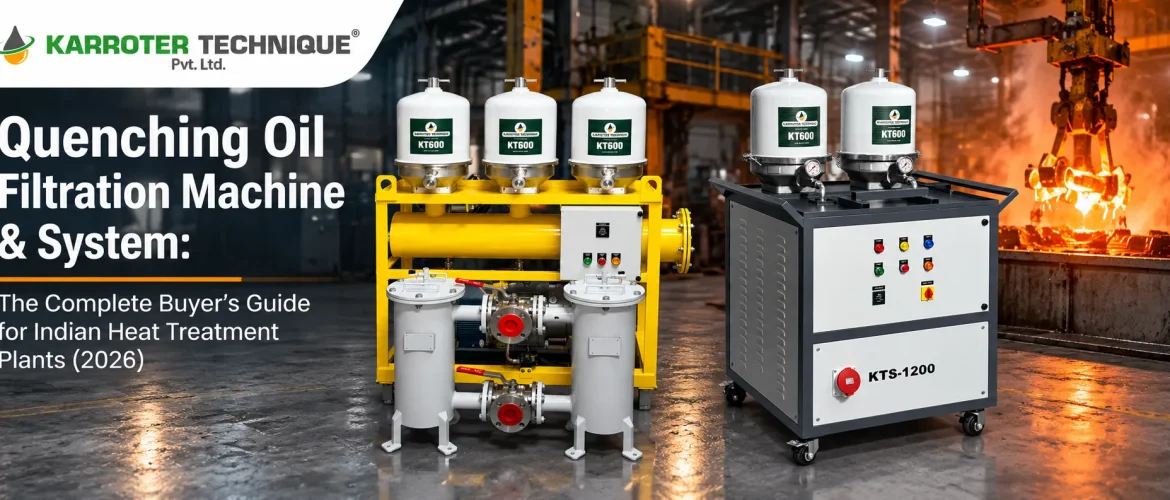
A quenching oil filtration machine is the single most overlooked upgrade in most Indian heat treatment shops and it’s usually the first thing that should have been fixed. If your hardening line is producing inconsistent hardness readings, dark and sludgy quench oil, or surface finish that keeps drifting off spec, the oil itself is very likely the root cause, not the furnace or the parts. This guide walks through exactly what a quenching oil filtration machine does, how a quenching oil filtration system is built, what it costs in India in 2026, how to choose between manufacturers in Pune and across the country, and how to keep the whole setup running well for years. By the end, you’ll know whether your plant needs one, which type fits your tank size, and what questions to ask before you buy.
What Is a Quenching Oil Filtration Machine?
A quenching oil filtration machine is equipment that continuously removes soot, carbon and fine solid contamination from quenching oil so the oil keeps its original cooling rate and quenching severity. Every hardening cycle leaves a small amount of debris behind burnt carbon from the quenching reaction itself, scale flaking off hot parts, and fine dust drawn in from the shop floor. Left alone, that debris builds up cycle after cycle until the oil is thick, dark, and no longer cools parts the way it did when it was new.
Unlike a simple strainer that just catches large chunks of debris, a proper quenching oil filtration system is designed to run continuously, pulling oil out of the tank, cleaning it, and returning it all while the hardening line keeps producing. That’s the real difference between “having a filter” and “having a filtration system.”
How a Quenching Oil Filtration System Differs from a Standard Oil Filter
A standard cartridge or mesh filter works by trapping particles inside a physical barrier. It’s cheap to install but expensive to run, because every cartridge eventually clogs and has to be thrown away and replaced which is exactly the ongoing cost a well-chosen quenching oil filtration machine is meant to eliminate. A quenching oil filtration system built around centrifugal separation works differently: it spins the oil at high speed and uses centrifugal force not a barrier to throw soot and sludge to the outer wall of a rotor, where it’s collected and cleaned out periodically. No consumable element, no recurring purchase, and no drop in flow rate as the unit fills up.
Why Does Quenching Oil Get Contaminated?
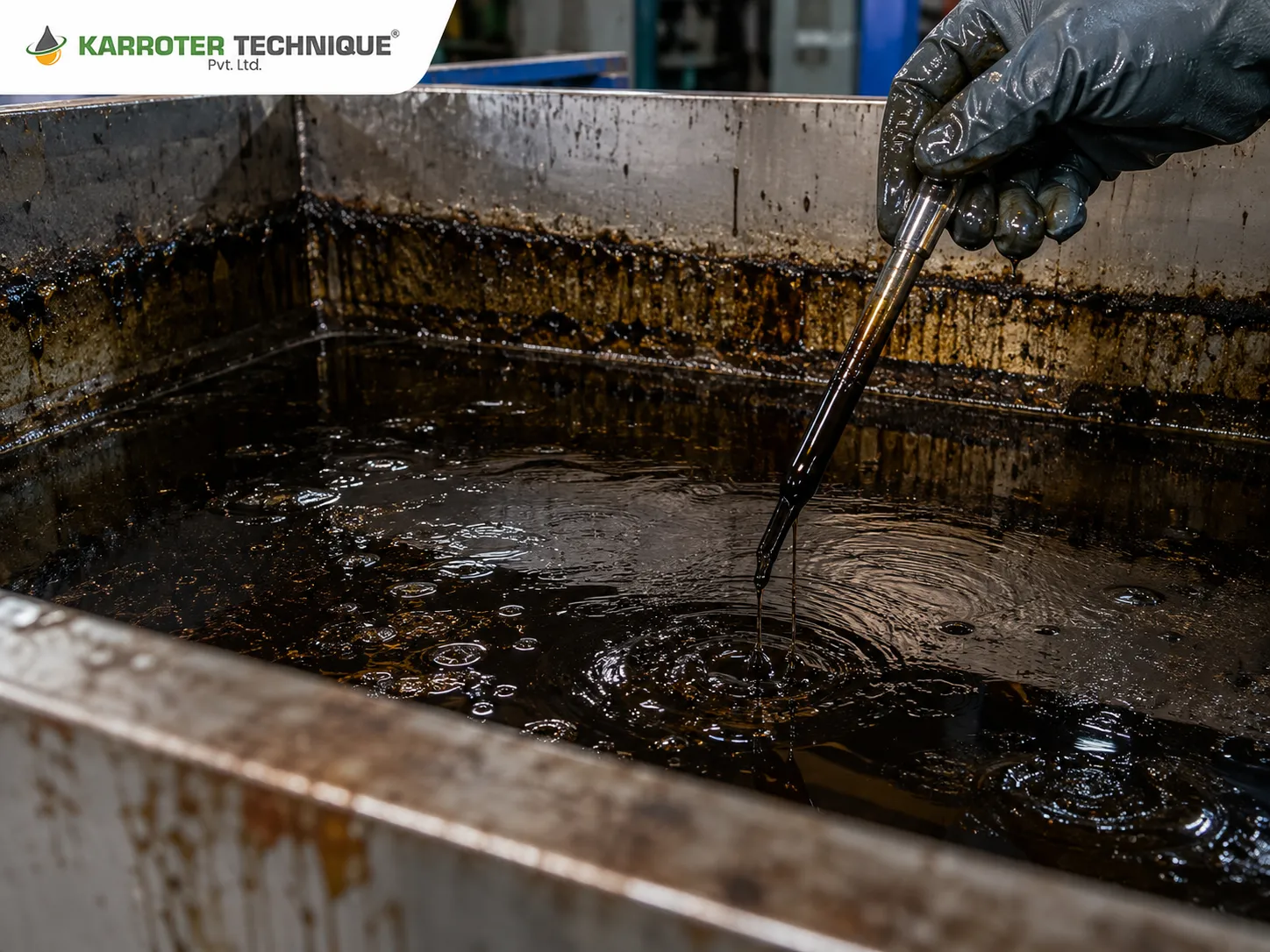 Quenching oil doesn’t fail suddenly. It degrades gradually, and understanding why helps explain why filtration not just periodic oil changes is the fix that actually works.
- Thermal cracking: every quench cycle exposes the oil to extreme, rapid temperature change, and a fraction of the oil breaks down into carbon and soot with each pass.
- Scale and debris from parts: hot components shed fine oxide scale into the bath as they cool.
- Airborne dust: open quench tanks in busy forging or hardening shops pull in shop-floor dust constantly.
- Oxidation: exposure to air at high temperature slowly oxidises the oil, forming sludge and increasing viscosity.
- Cross-contamination: water ingress from leaking coils or humid environments can further destabilise the oil.
Signs Your Quenching Oil Needs a Filtration System
If you’re seeing any of the following, it’s worth getting your oil tested and looking at a dedicated quenching oil filtration machine rather than just scheduling another full oil change. In our experience, plants that wait until oil looks visibly black before considering a quenching oil filtration machine have usually already absorbed months of avoidable rejected parts:
- Hardness readings that vary across a batch that used to be consistent
- Visible sludge or a layer of soot settling at the bottom of the tank
- Darkened, hazy finish on hardened components
- Slower-than-normal cooling during the quench, or a rising bath temperature
- Existing strainers or mesh filters clogging far more often than before
| Contamination Type | Source | Effect on Quench Quality |
| Carbon / soot | Thermal cracking during quenching | Slower, uneven cooling rate; darker finish |
| Oxide scale | Hot parts entering the bath | Surface pitting, scratch marks on components |
| Sludge / varnish | Oxidation over time | Increased viscosity, reduced heat transfer |
| Dust | Open tank, shop-floor environment | Accelerates sludge formation, clogs strainers |
| Water | Leaking cooling coils, humidity | Foaming, corrosion, inconsistent hardening |
How Does a Quenching Oil Filtration Machine Work?
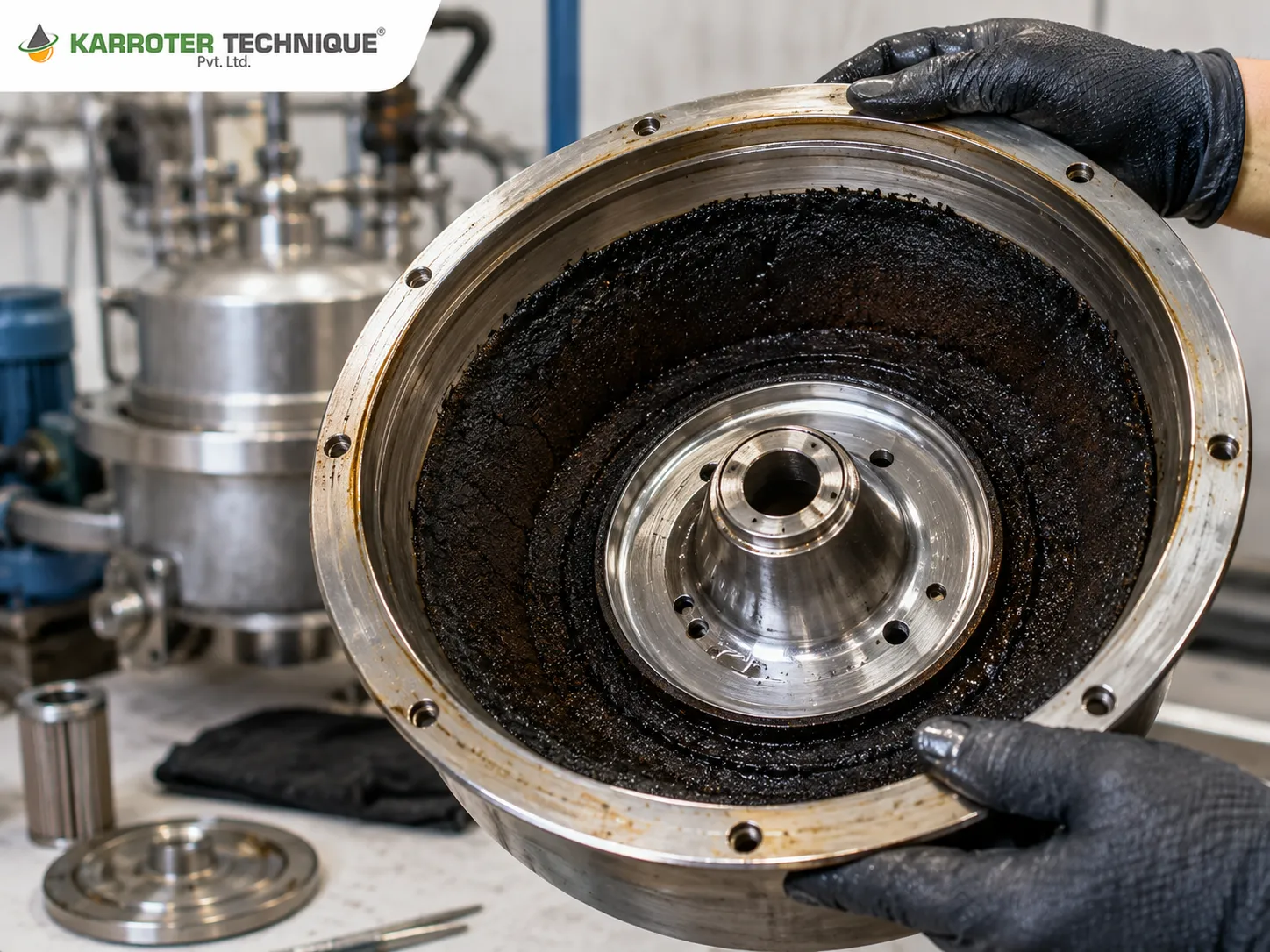 Most modern quenching oil filtration machines use centrifugal force, running offline and continuously alongside the quench tank, to remove contamination without any consumable filter element. The unit draws oil from the tank through a suction line, spins it inside a cleanable rotor at high RPM, and separates solids by density before returning clean oil to the tank. Because the process runs in parallel with production, there’s no need to stop the hardening line to filter the oil.
Centrifugal vs Cartridge vs Vacuum Filtration for Quenching Oil
Different quenching oil filtration systems use different separation principles, and each has trade-offs worth understanding before you buy:
| Method | How It Works | Best For | Drawback |
| Centrifugal filtration | Spins oil to separate solids by density into a cleanable rotor | Continuous, high-volume operation with zero recurring element cost | Higher upfront investment than a basic cartridge filter |
| Cartridge / mesh filtration | Traps particles physically in a disposable element | Small tanks, light contamination loads | Recurring element cost; clogs quickly under heavy soot loads |
| Vacuum filtration | Uses pressure differential to draw oil through fine media | Removing dissolved gases and fine moisture alongside solids | More complex system, higher maintenance, less common for pure quench-soot removal |
For most quenching applications where the dominant contaminant is fine carbon and soot rather than dissolved water centrifugal separation is the industry’s default choice precisely because there’s nothing to keep buying.
Benefits of Installing a Quenching Oil Filtration System
A well-sized quenching oil filtration machine pays for itself in ways that go beyond simply having cleaner oil in the tank:
- Consistent hardness and quench severity across every batch, not just the first few after an oil change
- Zero consumable cost with centrifugal designs one rotor, cleaned and reused indefinitely
- Fewer rejected parts from surface staining or inconsistent hardening
- Longer oil life, which reduces disposal frequency and the associated environmental and compliance burden
- Reduced strain on existing strainers and mesh filters, extending their service interval
- No production downtime, since offline units filter continuously while the line runs
Applications & Industries That Rely on Quenching Oil Filtration Machines
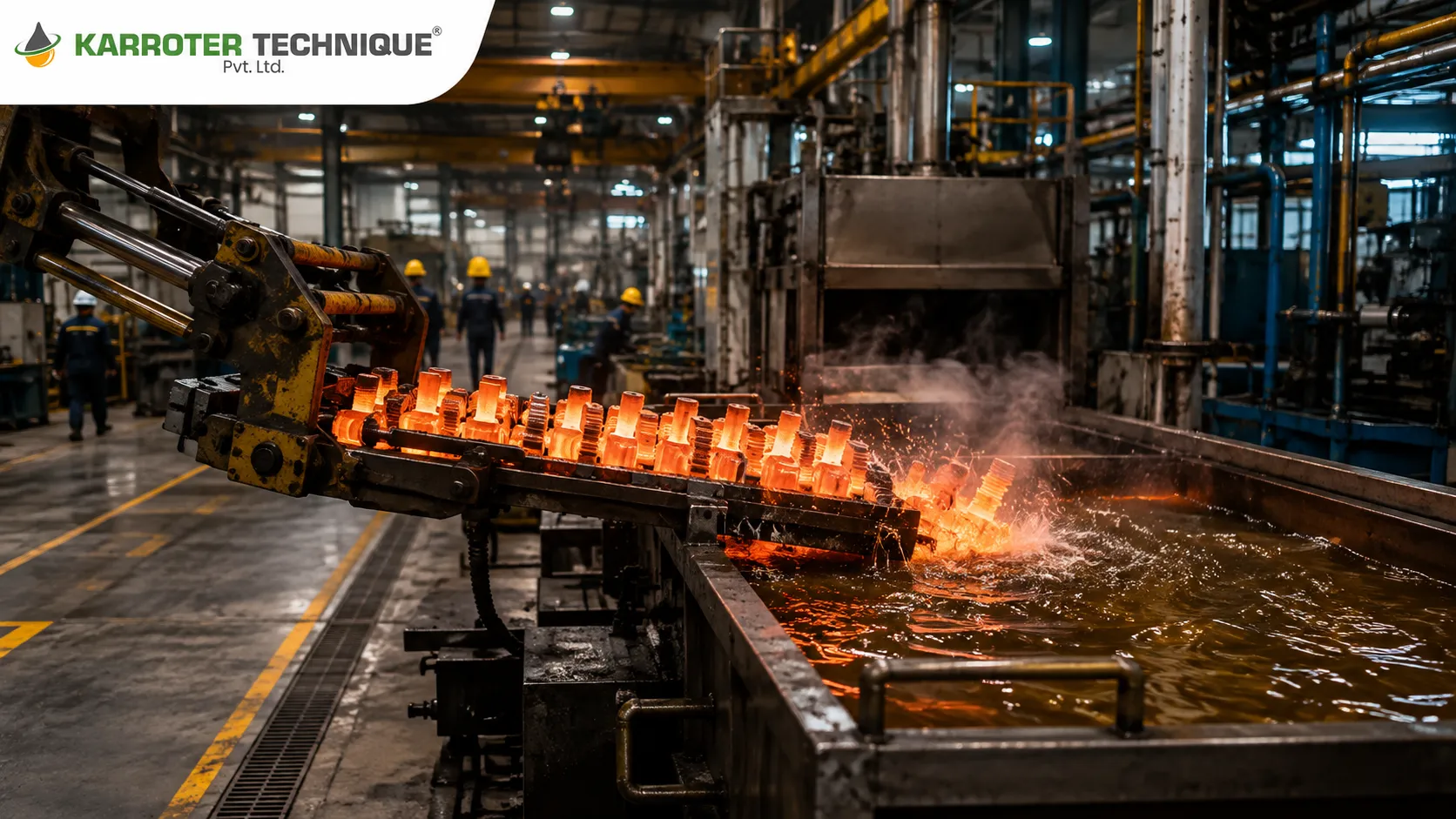
A quenching oil filtration machine is used wherever steel or alloy components are hardened by rapid cooling in an oil bath, including:
- Forging and hardening lines
- Fastener and bearing manufacturing
- Automotive component heat treatment
- Gear and transmission part hardening
- General foundry and metalworking heat-treatment shops
Quenching Oil Filtration Machine Price in India – What Affects the Cost?
This is one of the most searched questions around quenching oil filtration machines, and the honest answer is: it depends heavily on capacity and technology. Based on current market listings for quenching oil filtration equipment in India, small manual units for modest tank sizes start in the range of roughly ₹1 lakh, while mid-capacity centrifugal systems typically fall between ₹2–4 lakh, and larger skid-mounted systems built for high-volume forging or fastener plants can run ₹10–12 lakh or more.
| Factor | Impact on Price |
| Tank / bath capacity | Larger capacity requires a bigger rotor and motor, raising cost |
| Filtration technology | Centrifugal systems cost more upfront but eliminate recurring element expense |
| Automation level | Touchscreen HMI, particle counters and sensors add to base price |
| Portability vs fixed installation | Portable skid units are typically more cost-effective for multi-tank plants |
| After-sales support | Local installation, commissioning and service coverage affects total cost of ownership |
A useful way to think about it: a cartridge-based system looks cheaper on day one, but every replacement element is a recurring cost that adds up over the machine’s working life. A centrifugal quenching oil filtration machine costs more to buy but effectively has a zero-consumable running cost after that.
Quenching Oil Filtration Machine Manufacturers in India
India has a healthy base of quenching oil filtration machine manufacturers, ranging from large multi-product suppliers covering many oil types to specialists focused purely on centrifugal separation. Rather than picking on price alone, it’s worth evaluating manufacturers against a short checklist:
- Proven capacity match – can they size a unit correctly for your actual tank volume and duty cycle, not just sell you their standard model?
- Centrifugal, consumable-free technology – avoids locking you into ongoing cartridge purchases
- Local installation and commissioning support – critical for uptime, especially outside major industrial hubs
- Track record in heat treatment specifically – general oil filtration experience doesn’t always translate to quenching-specific duty cycles and temperatures
- After-sales service response time – ask how quickly a technician can reach your plant if something needs attention
Quenching Oil Filtration Machine Manufacturers in Pune
Pune is one of India’s strongest industrial hubs for oil filtration equipment, home to forging, automotive component, and fastener manufacturing clusters that generate steady demand for quenching oil filtration systems. If your plant is in or near Pune, working with a locally based manufacturer has a real practical advantage: faster installation turnaround, easier access to spares, and a shorter response time if a unit needs servicing. Karroter Technique is based in Narhe, Pune, and designs, manufactures and commissions quenching oil filtration machines and systems for heat-treatment plants across India.
Karroter’s Quenching Oil Filtration System – Built for Your Tank Size
At Karroter, our quenching oil filtration machines are built around the same centrifugal technology used across our full filtration range, sized to match tanks from a few hundred litres up to large multi-heater installations.
| Model | Tank Capacity | Best Suited For |
| KT 200 | Up to 400 litres | Small hardening lines, single quench tanks |
| KT 400 | 400 – 1,000 litres | Mid-size forging and fastener operations |
| KT 600 | 1,000 – 3,500 litres | Larger hardening lines |
| Custom Skid | Up to 30 KL | High-volume heat-treatment plants |
Every Karroter quenching oil filtration system removes solid contamination down to roughly 1 micron at around 99% efficiency, runs offline without interrupting production, and needs nothing more than a scheduled rotor clean-out no cartridges, no recurring element cost, no exceptions. Our centrifugal oil filtration skids and centrifugal oil cleaner product lines use the same core separation principle, so if your plant already runs Karroter equipment elsewhere, a quenching oil filtration unit integrates without introducing a new maintenance approach to learn.
How to Choose the Right Quenching Oil Filtration Machine for Your Plant
Picking the right quenching oil filtration system comes down to a handful of practical questions, not just comparing price tags:
- What’s your actual tank volume? Undersizing a unit means it can’t keep pace with contamination load; oversizing wastes capital.
- What’s your duty cycle? A single-shift operation has very different filtration needs than a 24/7 forging line.
- Do you need portability? Multi-tank plants often benefit from a wheeled skid unit that can move between quench stations.
- Is automation worth it for you? Touchscreen controls, particle counters and moisture sensors add cost but reduce the need for manual monitoring.
- What’s your installation timeline? Centrifugal units generally install faster than complex vacuum systems, since there’s less ancillary equipment involved.
- Who provides after-sales support? A quenching oil filtration machine is a long-term asset service response matters as much as the initial purchase.
Maintenance & Best Practices for Quenching Oil Filtration Systems
A quenching oil filtration machine is low-maintenance by design, but “low” isn’t “zero.” Getting the most out of your quenching oil filtration machine over its working life comes down to a few consistent habits:
- Clean the rotor on a fixed schedule, not just when performance visibly drops waiting for a problem means contamination has already built up.
- Monitor oil temperature and viscosity periodically to catch oxidation trends early.
- Keep the tank covered where practical to reduce airborne dust ingress.
- Log hardness results by batch so any drift in quench severity is caught quickly, rather than after a run of rejected parts.
- Inspect suction and return lines during routine maintenance to avoid unnoticed leaks or restrictions.
Quenching Oil Filtration Machine vs Full Oil Change – Which Actually Costs Less?
It’s tempting to just schedule a full oil change instead of investing in a filtration system, but the numbers usually don’t favour that approach once you account for downtime, disposal and quality risk.
| Factor | Full Oil Change | Quenching Oil Filtration Machine |
| Recurring cost | New oil purchase every cycle | One-time investment, minimal running cost |
| Downtime | Line stopped during drain and refill | None filters continuously while running |
| Consistency | Oil quality drops steadily until the next change | Stays close to original condition continuously |
| Disposal | Regular hazardous-waste disposal volume | Sludge only far smaller disposal footprint |
| Long-term cost | Higher over 2–3 years | Lower after the initial payback period |
The full oil change route isn’t wrong for every plant very low-volume operations may genuinely not need a dedicated quenching oil filtration machine but for any hardening line running regular production, letting oil quality decline between changes is an expensive, avoidable habit that a continuous quenching oil filtration system removes entirely.
Frequently Asked Questions
What is a quenching oil filtration machine used for?
A quenching oil filtration machine is used to continuously remove soot, carbon and fine solid contamination from quenching oil in heat-treatment operations, keeping the oil’s cooling rate and quench severity consistent so hardened parts meet spec batch after batch.
How much does a quenching oil filtration machine cost in India?
Prices vary by capacity and technology small manual units start around ₹1 lakh, mid-capacity centrifugal systems typically range ₹2–4 lakh, and large skid-mounted systems for high-volume plants can run ₹10–12 lakh or more. Contact a manufacturer directly for a quote matched to your actual tank size.
Which is better for quenching oil: centrifugal or cartridge filtration?
Centrifugal filtration is generally the better long-term choice for quenching oil because it removes fine soot continuously without any disposable element, while cartridge filters need frequent, costly replacement, especially under heavy contamination loads.
Can a quenching oil filtration system run while the hardening line is operating?
Yes. Offline centrifugal units are designed to draw from and return to the quench tank continuously while production runs, so there’s no need to stop the line for filtration.
How often does a quenching oil filtration machine need maintenance?
Routine maintenance is limited to periodic rotor clean-out on a schedule based on contamination load, plus occasional inspection of suction and return lines there are no filter cartridges to replace on a centrifugal system.
What type of oil is commonly used for quenching?
Mineral quench oils and fast or martempering-grade quenching oils are the most common choices in Indian heat-treatment plants, selected based on the cooling rate required for the specific steel grade and part geometry being hardened.
Do quenching oil filtration machines work for other oil types too?
The same centrifugal principle used in quenching oil filtration also applies to hydraulic, lube, gear and thermic oils many plants run one filtration platform across multiple oil types on site.
The Bottom Line
A reliable quenching oil filtration machine turns oil quality from a recurring headache into a solved problem. Inconsistent hardness, dark oil, and rising rejection rates aren’t furnace problems more often than not, they’re quenching oil filtration problems. A dedicated quenching oil filtration machine, sized correctly for your tank and duty cycle, removes the guesswork: it runs continuously, needs no consumables, and keeps quench severity where it should be, batch after batch. Given the choice between repeated full oil changes and a one-time investment in a proper quenching oil filtration system, the filtration route wins on cost, consistency and uptime for almost every plant running regular production.
Ready to Fix Your Quench Oil Contamination?
If your quench oil is looking dark, your hardness readings are inconsistent, or you’re simply due for an upgrade from cartridge filtration, get in touch with Karroter tell us your tank capacity and cycle volume, and we’ll recommend the right quenching oil filtration system for your plant.
For further technical background on how oil cleanliness is measured and why it matters for hydraulic and quench applications, see this independent explainer on ISO 4406 vs NAS 1638 cleanliness standards.
Related reading from Karroter: